What does a POTS headache feel like?
POTS Headache: Understanding the Connection Between POTS and Migraine
If you live with POTS and migraine, you may already know that your symptoms don't always stay in one lane.
You might have a headache that gets worse when you're standing. Maybe your heart starts racing when you get up, you feel lightheaded or unsteady, and suddenly the lights feel too bright. Exercise that used to feel manageable leaves you wiped out. Some days, brain fog or nausea is just as disruptive as the headache itself.
And sometimes it can feel like your body is reacting to everything at once.
You're not imagining that connection.
Research shows that POTS and migraine frequently occur together. While we don't yet have one simple explanation for why, changes in the autonomic nervous system, circulation, sensory processing, and the body's response to physical demands may all play a role.
What is a POTS headache?
POTS, or postural orthostatic tachycardia syndrome, affects the way your body responds to being upright.
When you stand, your body has to adjust to gravity and keep enough blood circulating to your brain and the rest of your body. With POTS, that adjustment can be more difficult.
You may notice:
A rapid increase in heart rate when standing
Lightheadedness or dizziness
Fatigue
Brain fog
Nausea
Exercise intolerance
Headache or migraine
Feeling worse after standing for a long time
Symptoms that improve when you sit or lie down
For some people, headache is one of the most noticeable parts of their POTS experience.
But there is an important distinction:
A headache associated with POTS isn't necessarily the same thing as a migraine.
You can have POTS and migraine at the same time. You can also have a headache that is influenced by your body's response to being upright.
Understanding which patterns you're experiencing matters and is something I often work on in my clinic with the patients that I see.
Why do POTS and migraine often occur together?
Migraine is much more than a headache.
It involves the brain's ability to process information from many different systems, including pain, vision, movement, balance, and the autonomic nervous system.
The autonomic nervous system helps regulate things you don't have to think about—your heart rate, blood pressure, circulation, digestion, temperature regulation, and your response to physical demands.
And research suggests that this system can behave differently in people with migraine.
A 2024 systematic review and meta-analysis found differences in autonomic responses between people with migraine and people without migraine during several physiological challenges, including standing, deep breathing, and sustained muscle activity.
That doesn't mean that migraine is an autonomic disorder.It means that the autonomic system may be one piece of the migraine puzzle.
Why can standing make a headache worse?
When you stand up, gravity pulls blood toward your lower body.
Your body normally responds by adjusting heart rate and blood vessel tone to help maintain circulation.
For someone with POTS, that response can be different.
You may notice:
Stand → heart rate increases → dizziness or lightheadedness → headache, nausea, fatigue, or brain fog
For someone who also has migraine, that additional physiological demand may be enough to push them closer to their symptom threshold.
This is one reason a person may say:
"My migraine is worse when I'm standing."
That pattern is worth paying attention to.
It doesn't necessarily mean that POTS is causing the migraine. It may mean that your autonomic system is one of several factors influencing how your symptoms behave.
Your symptoms don't have to fit into one box
One of the most frustrating things about migraine and POTS is that symptoms can overlap.
Dizziness could be related to migraine, POTS, your vestibular system, or several things at once.
Fatigue could reflect poor sleep, an autonomic response to activity, migraine, medication effects, or simply doing more than your body can currently tolerate.
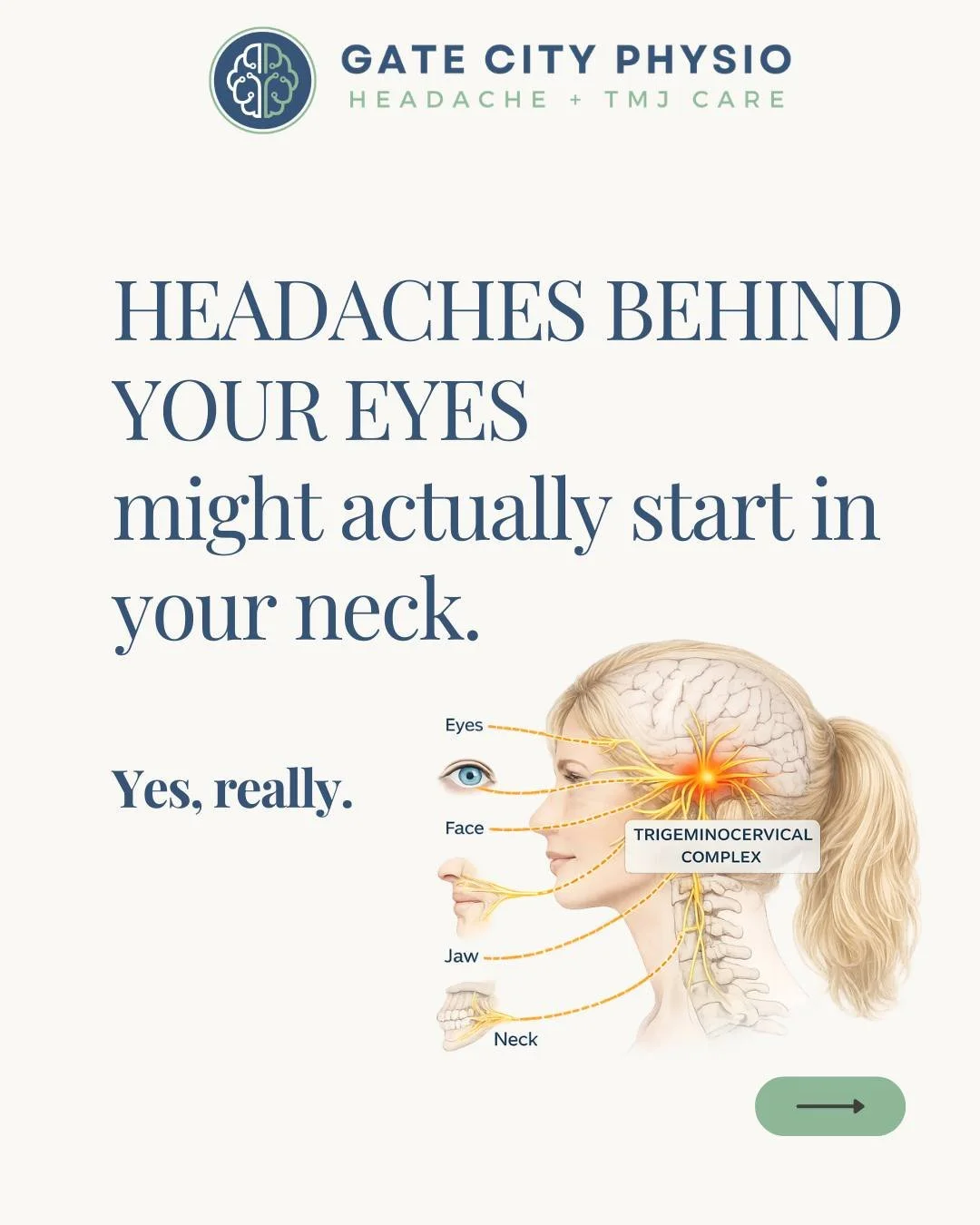
A headache could be migraine. It could have an orthostatic component. Your neck or jaw could be contributing. Or several of these things could be happening together.
This is why as a headache specialist, I don't believe in treating the diagnosis instead of the person. I want to understand your pattern.
Migraine has a threshold
One way to understand migraine is to think about your symptoms as having a threshold.
Your brain and body are constantly taking in information and responding to demands.
That includes:
Physical activity
Standing
Visual stimulation
Head and body movement
Sleep
Hydration and nutrition
Hormonal changes
Stress
Illness
Neck and jaw input
Sensory stimulation
Any one of these may be manageable on its own.But when several demands pile up, you may reach a point where your system has a harder time keeping up.That's when symptoms can become louder.
The goal isn't to avoid everything that makes you symptomatic.The goal is to understand what your body can handle today—and gradually build its capacity over time.
Where does physical therapy fit?
When POTS and migraine overlap, we don't want to look at only one part of the picture.
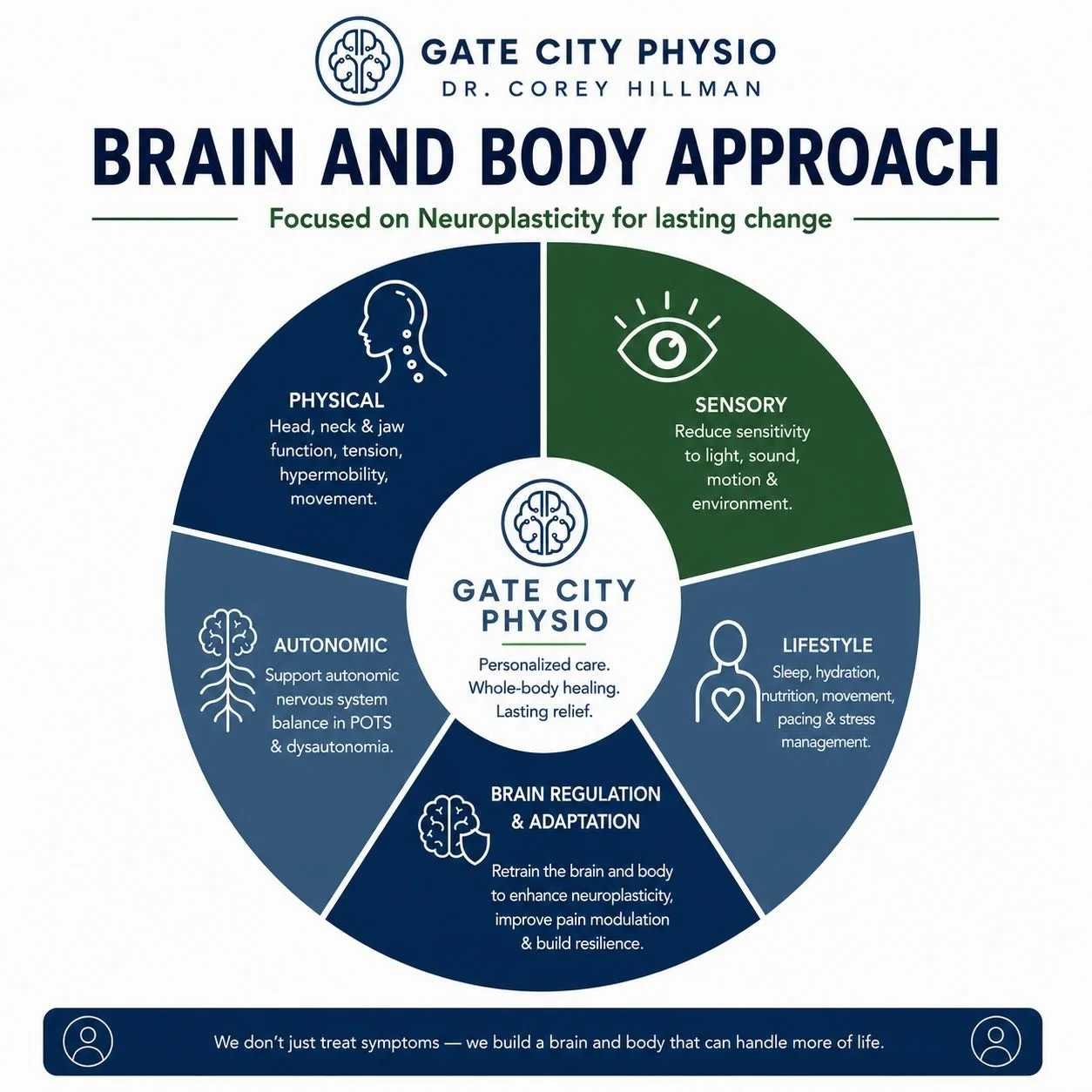
At Gate City Physio, we look at how several systems work together.
Your body
We may look at your neck, jaw, posture, movement, mobility, and muscular control.
Your sensory systems
We may look at your eyes, vestibular system, balance, head movement, and how you respond to visually or physically complex environments.
Your autonomic system
We may look at how your heart rate and symptoms respond to changes in position, physical activity, and recovery.
None of these tests tells us why you have migraine by itself.
Instead, they help us build a clearer picture.
What happens when you stand?
What happens when you move your head?
How does your heart rate respond to activity?
How quickly do you recover?
What happens when your visual and vestibular systems are challenged?
How does your neck or jaw respond?
These details can help us understand where your current limits are—and where we can begin building capacity.
You don't have to live in a smaller world
When POTS and migraine are both part of your life, it can be tempting to start organizing everything around avoiding symptoms.
Maybe you stop exercising because you don't know how your body will respond.
Maybe you avoid busy stores because the lights and movement are too much.
Maybe standing through dinner is exhausting.
Maybe plans with friends, travel, work, or time with your kids require more recovery than they used to.
Over time, life can become smaller without you realizing it.
Our goal isn't to tell you to simply "push through."
It's to help you understand your symptoms, find the right starting point, and gradually build the capacity to do more of the things that matter to you.
When should a headache be evaluated?
A new or significantly different headache deserves medical attention, especially if it is sudden or severe, associated with new neurological symptoms, or substantially different from your usual pattern.
Positional headaches also deserve careful consideration. A headache that consistently becomes worse when upright can have several possible causes, and POTS is only one of them.
Your medical team can help determine whether additional evaluation is appropriate.
POTS and migraine: looking at the whole picture
Living with POTS and migraine can make it feel like your body is working against you.
But your symptoms aren't random.
There are connections between the systems involved in circulation, movement, sensory processing, and migraine—and understanding those connections can give you a clearer place to start.
At Gate City Physio, we take a brain-and-body approach to complex headache and migraine.
We look beyond the headache itself to understand how your body responds to movement, sensory input, activity, and everyday demands.
Understand your symptoms.
Build capacity.
Get back to life.
If you are experiencing headaches, neck pain, or TMJ in or near Greensboro, North Carolina, please book a consult call and let's get you back to enjoying your life!